In 2022 you put money behind changing what professional tennis pays its players. Four years on, that fight is in a courtroom. This is the other route: a league that already pays them, with no one to sue.
League-level equity · not a franchise
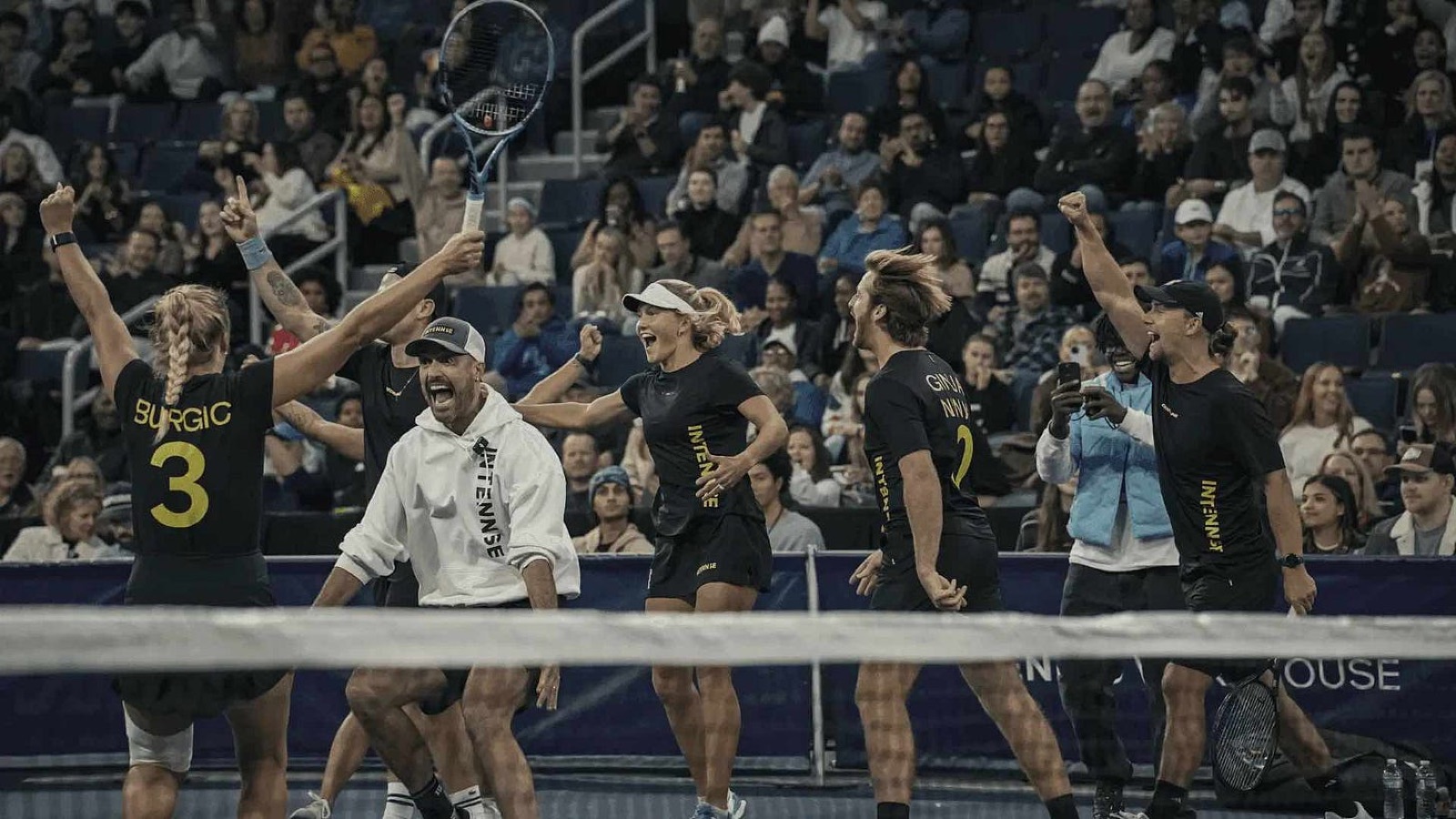
In the stands in Atlanta, watching his sister play · Season 2
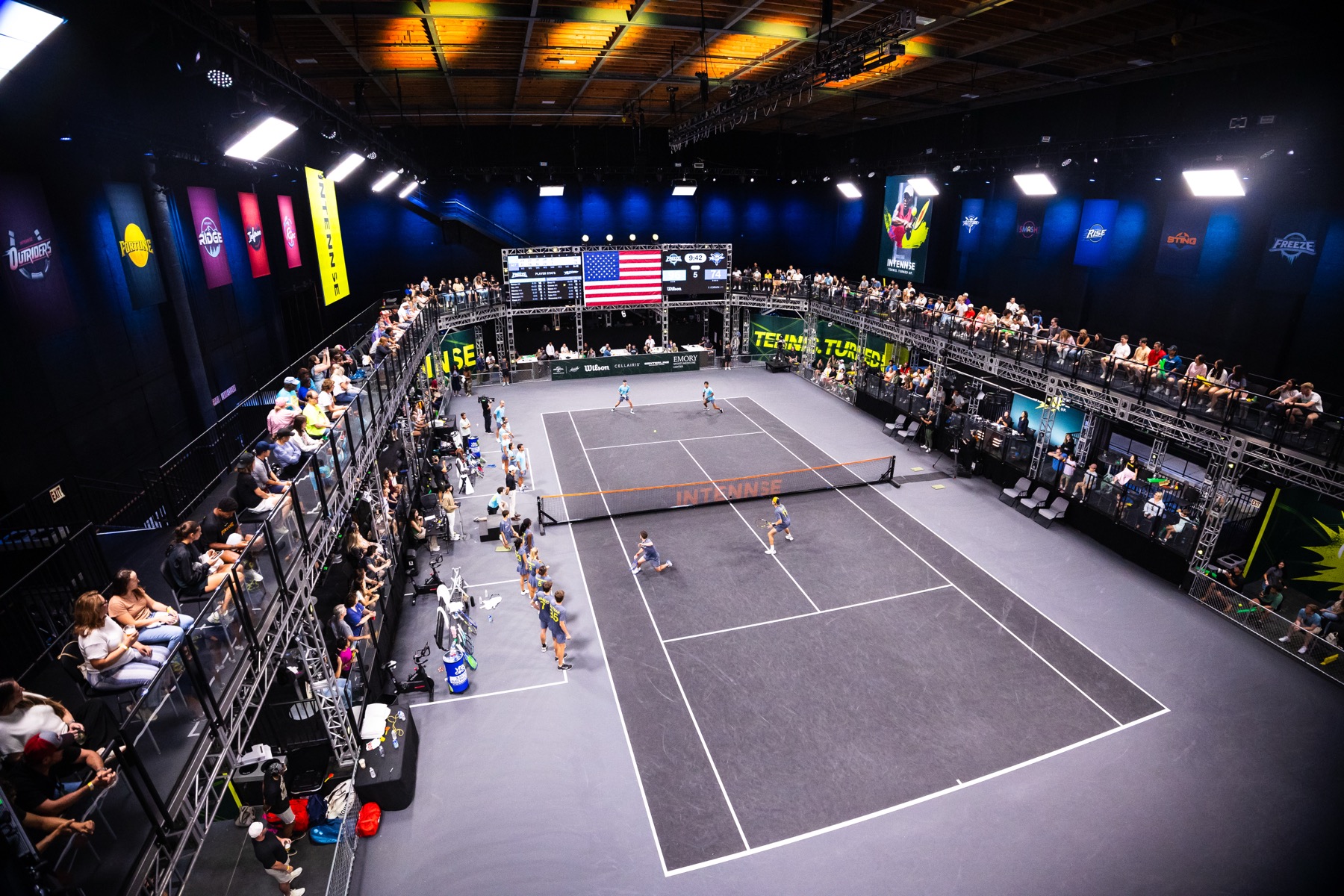
A gender-balanced Professional Team Tennis League
Eight playing weeks in the middle of the summer. Switch the view to see the
same season against the American sports year, or against the college calendar our players come from.
INTENNSE Grand Slams Team events
INTENNSE Regular season Postseason
INTENNSE Regular season Postseason & championships
2026 season. INTENNSE: 5 June – 1 August, 58 days, one dark week for Wimbledon. Sources: data.intennse.com/2026/calendar.tsv; published tournament calendars.2026 calendar year. The NBA and NHL finished on 13 and 14 June; the NFL’s season opens 9 September; LOVB ran January to April. Only MLB is in season through INTENNSE’s eight weeks. Sources: published league calendars; INTENNSE figures from data.intennse.com.NCAA Division I, 2026 as it happened. Both the men’s and the women’s team championships finished on Sunday 17 May at the Dan Magill Tennis Complex in Athens, Georgia — Virginia over Texas, Texas A&M over Auburn. The NCAA has moved singles and doubles out of May: they are now a November event, so a graduating senior has nothing left on the college calendar at all. Basketball’s season opened in November 2025; the January football block is the 2025 season’s playoff. D-I carries 5,207 tennis players across 541 programmes. Sources: ncaa.com championship releases, official school schedules, NCAA Sports Sponsorship and Participation Rates Report 2024–25.
Down to the wire; Sudden Death
Two Arcs that finished a point apart. Each clip picks up in the closing minutes,
with the full Arc a click away.
Sudden death, level at 142
The final three minutes of Freeze v Rise, 20 June. The clock runs out with the teams tied, and the next point decides it: 143–142.
You have made the argument for this league three times, in public, without knowing it.
In 2022 you said you had “long recognized the challenges that most professional
tennis players experience due to the sport’s inferior economics for all but the very top of
the rankings ladder.”
In March 2025 you said the sport’s abuses had been allowed to metastasize because of its
power dynamics. Last month you said a $363 grounds pass on day one of the US Open was absurd for
an organisation with non-profit status.
Underpaid players. Governance that answers to nobody. Fans priced out. We built
a league that answers all three, and it did not require anyone to be sued.
Players are paidA $40,000 base wage for an eight-week season, up to $70,000
with performance. Employees, not entrants.
Nobody governs usNo sanctioning body, no ranking points to withhold, no
calendar to be granted a slot in.
Tickets are cheapAn Arc is about an hour and forty minutes and priced for a
family, not a corporate box.
■ The question you will ask first
Prize money is committed before a season is sanctioned.
Not pledged, not contingent on a round closing, not dependent on a co-investor honouring a
term sheet. Committed — and paid, across two completed seasons. Every player who
has taken the court for INTENNSE has been paid what they were promised, on time.
We know what the last few years have done to the credibility of new leagues, and we know
that the first question a serious person asks is not about the format. It is whether the
athletes get their money when something goes wrong. Ours is a wage obligation to employees,
funded ahead of the season, not a prize pool assembled while the season runs.
■ Why the economics are broken
Break-even on tour is about 150 in the world. Almost nobody is above it.
The ITF’s own figures put break-even at 336 for men and 253 for women
— but those costs exclude coaching, which every professional carries. Counted properly,
a peer-reviewed 2026 study puts it near 150. Of the men on our rosters who
have ever held a ranking, not one reached that number. On today’s
rankings it is unanimous across both panels.
This is the structural fact under everything you have said about the sport.
Tennis produces thousands of professionals and pays a few dozen. Every player we drafted is
below the line; the chart is here.
Where the money goes instead
Where our players have been on the tour, and where they sit on the rating that
covers everyone. The orange rule is where tennis starts paying for itself.
Career high September 2026MVP race ↗ (second scale) alone = no tour ranking, placed by MVP standingName in yellow = straight from college
Rounds 1–3 of the 2026 draft, plus three players the draft board leaves out altogether and one fourth-round pick: 56 in all. Forty-seven carry an ATP or WTA career high. The nine below the dotted line in each panel have no tour ranking on record and are placed by where they finished in the league’s own MVP race — among them Sofia Cabezas, fifth in that race, and Corey Craig, thirteenth, straight out of Florida State. Two more carry a career high but no current singles ranking, so they show a career-high dot alone. Fourth-round picks are otherwise excluded — 2027 rosters are three women and three men. The one exception is John Chin, 19th of 31 men over four Arcs, ahead of eight higher picks including two first-rounders. A player placed by MVP standing needs more than one Arc behind the number: Season Score is the sum of a player’s best six rounds divided by six, so a single appearance is not a season. Ranking axis runs worst to best, left to right, as in the UTR chart below. The MVP race is a separate scale, and it stops at our own best-ranked player rather than running the width of the chart — it ranks these players against each other inside the league, not against the tour. Aliona Bolsova sits inside that line on both counts: a career high of 88, inside a Grand Slam draw, and first in the 2026 MVP race. A career high is never drawn worse than the player’s current ranking: where a recorded best is stale, the best is at least today’s rank and the two collapse to a single point. Tier cut-offs: main draw top 128 — the draw size of a Grand Slam — Challenger 129–350, ITF Futures 351–900 (the ITF renamed the Futures circuit the World Tennis Tour in 2019). The orange rule is the break-even ranking — where prize money covers the cost of competing. It is drawn at ~150, which is where a peer-reviewed 2026 study puts it once a realistic cost base including a coach is counted — and every professional has a coach. The faint rule behind it is the ITF’s own 2013 figure, 336 for men and 253 for women, which sits at a worse ranking only because those costs exclude coaching and all support-team expense. It is the bar nobody actually competes under. Against the real bar: of the 26 men here with a career high, all 26 never reached 150; of 21 women, 19 never did — the exceptions are Aliona Bolsova at 88 and Usue Arconada at 130. On today’s rankings it is unanimous: 25 of 25 ranked men and 20 of 20 ranked women sit outside break-even. Sources: draft.intennse.com, stats.intennse.com MVP race, intennse.com player pages, Tennis Abstract, retrieved 20–21 September 2026; ITF Pro Circuit Review, Stage One: Data Analysis, December 2014; Schöttl et al., Social Sciences & Humanities Open, 29 June 2026.
UTR: our players against the tour’s
INTENNSE player Straight from collegeTop three picks per team Tour band (10th–90th percentile)
Bands derived from 286 players who publish both a UTR rating and an ATP/WTA ranking, taken at the 10th–90th percentile of each tier. INTENNSE ratings: the top three men and three women per 2026 roster — 28 men and 30 women carry a rating on the league’s own draft board. Source: draft.intennse.com players board, retrieved 20 September 2026.
■ The format
Three women, three men, one score. It is a product decision.
Every team puts three women and three men on court and they share a single
cumulative score. A point won by a woman counts exactly what a point won by a man counts,
because the scoreboard does not distinguish between them.
That is not a position. It is what makes the match work: it doubles the
number of athletes a broadcast can build a story around inside the same window, it makes
every set matter to a single running total, and it produces the finishes the league is known
for — two Arcs last season decided by one point. The format came first and the balance
fell out of it.
The Rules of INTENNSE, explained · 2:04
■ You already do this
You have been funding the American pathway for twenty years.
A teenage Frances Tiafoe, over a hundred thousand dollars for coaching and
travel. Robin Montgomery, through to a US Open women’s doubles final this month. Court
rebuilds in the Bronx and in Washington. And when an endowment to one institution did not
work out, ten million dollars pledged to the Junior Tennis Champions Center instead.
Every one of those is the same bet: that the constraint on American tennis is
not talent but what happens to talent between eighteen and twenty-five. That is the gap this
league occupies. Your money has been doing retail what a league does wholesale.
The years the sport loses people
■ What we are asking
A stake in the league, and a seat at the table. Not a franchise.
League-level equityThe property itself — the format, the draft, the
season, the media rights and the pathway under them. Not a team in a city.
A board seatA voice in how it grows: which markets, in what order, with which
owners. The league is operated by people who do it full time.
Not a team charterA local operating business with a venue and a
payroll. You have never bought one and we are not going to ask you to.
Not a playing roleEvery place on this court is earned. That is the
whole proposition and we will not sell exceptions to it.
The structure that fits is the one you have used before: foundation or family
office capital, a chair or board seat, and an operator who runs it. If it is worth an hour, we
will bring the model and the numbers.